Pert Em Heru
Original title: Pert Em Heru – Kilépés a fénybe
Oratorio for soprano, mezzo-soprano, tenor and bass soloists, mixed choir and symphony orchestra.
Duration: approx. 40 min
Text: Hungarian text translated and written by the composer, based on a German translation of the Egyptian Book of the Dead dating back 130 years.
Commissioned by the Béla Bartók International Choir Competition, Debrecen.
Composer’s Note
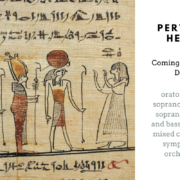
Pert Em Heru means Coming Forth into the Light. This is how the ancient Egyptians described the beginning of the soul’s journey after death. The Egyptian Book of the Dead contains prayers, monologues and testimonies associated with the sublime and terrifying moment of leaving earthly existence, and with the soul’s transformation into a god. Its texts are arranged in short chapters, “magical formulas” known as Ra-U.
Most of the several-hundred-page Book of the Dead is 5,000 years old, but some passages date back ten to fifteen thousand years. These words speak to us across an astonishing distance in time, yet their emotional world is strikingly familiar. They express recognisable feelings: fear, anxiety, hope and faith. Unlike the texts of the Christian Requiem, this collection does not concentrate on the grief of those left behind, pleas for divine mercy, punishment, forgiveness, or the appeasement and glorification of the Almighty. Instead, it reveals the experiences of the soul at the centre of these events: the one who has just “crossed the sacred threshold”.
The account unfolds in the first person, as direct experience. Avoiding lyrical embellishment, the soul describes its journey in practical terms. The power of the text lies not in poetic language but in the unfailingly moving intimacy of confession: a diary-like account of what the deceased feels and experiences from moment to moment.
This remarkable expression of ancient beliefs about death can still speak to us today because its language is direct, practical and free of grandiloquence. The soul, “stepping out into the radiant light”, responds in a profoundly human way. Almost overwhelmed by fear, it experiences abandonment, euphoria, paralysis, irresistible power, weakness, divine grace and demonic destruction. It feels at once utterly vulnerable and omnipotent. The text becomes an unstoppable torrent of experience at the threshold of death, interrupted only occasionally by a prayer or hymn.
Having endured the trials of the afterlife and proved sufficiently free of sin in the hall of the goddess Maat, the soul escapes the second, final death and may at last emerge into the full light of day. It becomes a god, “free to wander among the dead”. Now its own master, it may choose to fly from planet to planet, rest quietly from the hardships of life, or return to visit the Earth.
The Book of the Dead is filled with symbols and allusions, conveying an exceptionally complex body of religious knowledge. Because of the difficulties of translating its hieroglyphic texts and the disappearance of the culture that produced them, a complete understanding is no longer considered possible.
In selecting passages from this extraordinary journey, I was guided neither by a desire for scholarly authenticity nor by religious conviction, but by the possibilities for musical drama within the ancient text.
I first encountered the book in András Bánfalvi’s excellent Hungarian translation, based on Professor Kolpaktchy’s German rendering of the original Egyptian text. I then sought out this first German translation myself. Studying it closely, I decided to strip away the poetic elaborations of the Hungarian translation and prepare my own version: rougher, but as faithful as possible to the original text.
Working freely with the lines, I fashioned the libretto from this translation. A single aria may bring together words from several independent magical formulas. This was possible because the book does not present its experiences as a linear narrative. Instead, it returns repeatedly to much the same multitude of feelings, approaching them differently each time. In his preface, Bánfalvi calls it a “polyphonic fugue”, recognising its close affinity with music.
I retained this sense of a continuously flowing text. My forty-minute work proceeds without a break, its interconnected movements forming three distinct sections: three RA-U.
I. RA-U: Pert Em Heru
Choir, soprano solo and bass solo.
Instruments traditionally associated with ritual dominate the opening. Percussion and brass provide a swift, dramatic introduction to the whole work. Together, the choir and soloists proclaim the solemn moment of death: Pert Em Heru!
The opening is expansive and dramatic. Rather than conveying grief, it reflects the uncompromising force of the irreversible. Once death has been announced, the personal, lyrical prayers and pleas of those left behind repeatedly interrupt the prescribed discipline of the ceremony. Their response is heightened and passionate rather than sorrowful: Let the departed see as you do, hear as you do, and become like you! they demand of the gods.
The choir’s emphatic declaration gives way to a murmured prayer. Above dark clusters in the lower register, a low bassoon melody accompanies the first utterance of the deceased, who observes the murmuring priests as a disembodied spirit: I hear a voice from the Earth, murmuring sacred words. Before my coffin, the priest prays for me.
The vocal line begins in astonishment, then breaks into a lyrical outburst of pain. The formal ceremony, with its drums and resounding brass, is interrupted: the force of the soul’s two sentences transforms the musical situation established at the opening.
A passacaglia-like harp pattern, recalling Baroque arias, and an intimate string texture support the soprano’s tender, sorrowful aria of mourning: O gods, I call upon you… The choir softly echoes individual words, while dry piano arpeggios add an essentially percussive colour.
For her final phrase, the soprano rejoins the focused, impersonal world of the ritual, calling out with the other soloists: May the halo of peace shine upon the departed! This declaration shakes the music free of mourning and restores the opening tempo and atmosphere. The choir and soloists immediately answer one another, passing the phrase between them as their voices gradually fade.
A harsh cluster in the low strings emerges beneath them. The transition between the two large sections is shaped as an acoustic crossfade, with one texture receding as the other comes into focus.
II. RA-U: To Avoid the Second Death
The second RA-U begins with a bass aria: O Tum, what place have I come to? Its opening recalls recitativo accompagnato: improvisatory in character and filled with anxiety. Against static chords in changing instrumental colours, a trombone melody responds to the soloist’s phrases.
The aria proper is fragmented and somewhat macabre. Its foundation is a bass pattern of even staccato or pizzicato notes, developed through rhythmic diminution and augmentation in the piano, harp and low strings. Fleeting woodwind figures dart above it, while the xylophone sharpens the brittle sonority. The upper strings recall fragments of the aria’s melody at a distance, as if placing them in quotation marks.
Eventually, the bass soloist’s melody itself loses continuity, and the words become fragmented: The air is thin in my lungs… I am thirsty… There is no water… No water here… I thirst…
The dry, clicking texture regains direct emotional expression with the words Truly, no one finds peace here. An increasingly impassioned passage leads to an expressive outburst of self-pity: Let flowers bloom upon my grave!
This passionate cry silences the orchestra. Only occasional woodwind arpeggios remain above a quiet tremolo on timpani and bass drum. After the wary phrase I hear Tum’s voice…, the choir erupts: You have committed many evil deeds… The bass interrupts these accusations with defensive fragments, echoing the disturbed, broken character of the aria.
The demons’ aggressive assault ends abruptly. Framed by an oboe melody, the terrified, bewildered soul asks: What happens now? A resigned melisma signals the abandonment of all resistance.
Three benevolent spirits—soprano, mezzo-soprano and tenor—calm the demons’ destructive fury with echoes of diatonic harmony. Their wordless melodies answer one another above a rocking, repetitive texture in 9/8, soothing the despairing soul. Corresponding to the canonic exchanges between the soloists, the orchestra builds a flowing, bell-like texture of intricate polyrhythms.
I come to protect you! sing the soloists, introducing a few openly Romantic bars. After I am your daughter; I will protect you!, the layered diatonic writing and complex metres return. The passage culminates in a deliberately straightforward, powerful major-key cadence. Its obstinate, seemingly excessive repetitions propel the music into the third RA-U.
III. RA-U: To Open a Path into Heaven
A mezzo-soprano herald announces that the great goddess receives the souls. Her aria is energetic and triumphant. In its central section, the choir chants the names of numerous Egyptian gods over a flowing, repetitive accompaniment.
High woodwinds lead into the choir’s broad A-flat major chord: You have arrived in peace. You have arrived.
An echoing trumpet melody grows out of the mezzo-soprano’s final phrase and is repeated in canon by trumpets and woodwinds. This is the motif of the deceased, now transformed into a god. The tenor takes it up: Listen, the bolt of the gate is being drawn!
The triumphant realisation that final death has been escaped gives way to the tragedy of divinity: the prospect of eternal solitude. In an almost self-contained arioso, the tenor sings: I awaken. The halo of peace shines upon me. I shall not perish; I shall not disappear. I arrive. Behold, I enter my eternal home. I am a god, a solitary wanderer.
Solo violin and muted strings are joined by staccato figures in two flutes and by the harp. From this deeply moving passage, the tenor builds once more towards affirmation, with the ascending motif sounding behind him in trumpets and woodwinds: I am the mighty deity who brought himself into being. I am today. I am yesterday. I am tomorrow… I am Ra!
The music turns swiftly into the concluding fugato. The choir launches into an exuberant hymn of praise: Homage to you, Ra! Between the choral passages, the soloists proclaim Peace reigns in heaven! in broad, clear C major chords, like vocal fanfares. Throughout, the orchestral wind figures continue to evoke the tenor’s glory and ascent.
The choir eventually joins the soloists in their declaration of peace. A broad ritardando then brings the music back to stillness, briefly recalling the texture of the soprano’s mourning aria.
On just two pitches, tenor and bass sing the deceased soul’s final, quiet and distant words together: I watch the setting Ra. I fly like a bird. I wander freely among the dead.
Meanwhile, the choir offers words of reassurance: Now you wander along spacious heavenly paths. You cross the threshold of the great temple. Joined by the two female soloists, they sing: You rest gently upon your deathbed.
The harmony moves steadily down the circle of fifths. From the C major conclusion of the fugato, it reaches B-flat minor at this final sentence. The work’s closing words, Glory to you, Ra, are heard in B-flat major, with a subtly coloured Picardy third.
— Zsófia Tallér
Instrumentation
Soprano, mezzo-soprano, tenor and bass soloists; mixed choir and orchestra:
Piccolo, 2 flutes, 2 oboes, 2 clarinets in B-flat, bass clarinet in B-flat, 2 bassoons, contrabassoon; 5 horns in F, 3 trumpets in C, 2 trombones, 2 bass trombones, tuba; timpani; 3 percussionists (bass drum, taiko drum, snare drum, crash cymbals, suspended cymbal, triangle, crotales, roto-toms, tam-tam, glockenspiel, xylophone and tubular bells); piano, celesta, harp and strings.
Premiere
Kodály Philharmonic Orchestra Debrecen
Kodály Choir Debrecen
Ildikó Katalin Cserna — soprano
Marianna Bódi — mezzo-soprano
Zoltán Megyesi — tenor
Géza Gábor — bass
Conductor: Máté Szabó Sipos